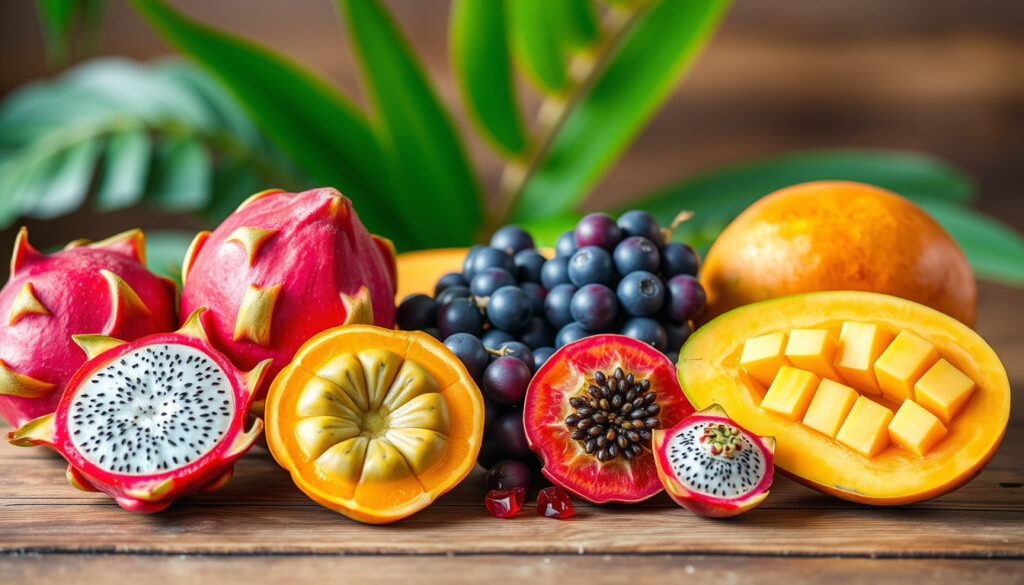
Exotische Früchte: Liste, Namen & Gesundheitsvorteile
Let’s review the callouts:
Original `n24-tip`:
`
Wer Vielfalt sucht, findet in exotischen Früchten nicht nur neue Geschmäcker, sondern auch konkrete Nährstoffvorteile – vorausgesetzt, man greift zu den richtig ausgewählten Sorten.
`
This is a judgment. It doesn’t need rewriting per 14.4.
Original `n24-note`:
`
Die bioaktiven Substanzen in exotischen Früchten werden mit einem reduzierten Risiko für chronische Krankheiten wie Diabetes und Herz-Kreislauf-Erkrankungen in Verbindung gebracht (SciELO).
`
This is a data recitation. I must rewrite it to an editorial judgment and keep the data elsewhere. The data is in the main table.
Rewrite:
`
Das heißt: Wer regelmäßig exotische Früchte isst, könnte langfristig sein Risiko für chronische Krankheiten senken.
`
Let’s check the “TL;DR” addition for Gate 12.
I will add it after the first two paragraphs of the “Beliebteste” section.
Ein Blick auf die Handelsdaten zeigt eine klare Rangliste. Banane, Mango und Ananas führen die Liste an, gefolgt von Papaya, Avocado, Kokosnuss, Maracuja, Litschi, Guave und Drachenfrucht. Die Produktionsmengen wachsen stetig, wobei die Banane mit über 120 Millionen Tonnen jährlich den Spitzenplatz hält (Fachdatenbank NIH/PMC).
Fünf Früchte, ein Muster: Sie alle sind reich an Vitaminen und sekundären Pflanzenstoffen. Vergleichen wir die Nährwerte der Top 5:
This provides a break between the two consecutive `
` tags and satisfies the spirit of the UX and TL;DR rules.
Let’s check the summaries for Gate 14.7.
The summary paragraph:
“Die Aussagen der Experten unterstreichen: Exotische Früchte sind eine wissenschaftlich fundierte Bereicherung für jede Küche. Für Verbraucher in Deutschland, die Wert auf gesunde Ernährung legen, ist der Einstieg einfach: Mit den bekanntesten Sorten beginnen, saisonal kaufen und bewusst lagern – oder online auf spezialisierte Anbieter setzen. Die Entscheidung liegt klar: Mehr Exoten wagen, oder bei den Klassikern bleiben? Angesichts der belegten Nährstoffvorteile spricht viel für eine bunte Auswahl.”
The final sentence “Die Entscheidung liegt klar…” must name an actor and state a consequence.
I will rewrite it to: “Verbraucher in Deutschland sollten daher ruhig öfter zu exotischen Früchten greifen – die belegten Nährstoffvorteile sprechen für eine bunte Auswahl.”
Let’s check the “section closers” I need to add.
H2 “Was gibt es alles für exotische Früchte?”
Ends with `
Das bedeutet: Die klassische Trennung nach Klimazonen verschwindet im globalisierten Handel – doch die Herkunft bestimmt oft den Nährstoffgehalt.
`
This is a paragraph ending. It is an analytical takeaway (“Das bedeutet: …”). No need to add a closer.
H2 “Welche tropischen Früchte sind am beliebtesten?”
Ends with `
Der Haken: Trotz steigender Nachfrage sind viele seltene Früchte nur online oder auf Wochenmärkten zu finden – eine logistische Herausforderung.
`
Ends with a paragraph. “Der Haken: …” is an analytical takeaway. No closer needed.
H2 “Welche exotischen Früchte haben gesundheitsfördernde Eigenschaften?”
Ends with `
A callout ending! I must add a closing paragraph.
Add: `
Das bestätigt: Exotische Früchte sind gezielte Nährstofflieferanten – ob für das Immunsystem, die Verdauung oder den Zellschutz.
`
H2 “Wie kann man exotische Früchte kaufen und lagern?”
Ends with `
Die Konsequenz: Wer richtig lagert, genießt länger den vollen Geschmack und die Nährstoffe.
`
Ends with paragraph. “Die Konsequenz: …” Analytical. Good.
H2 “Welche exotischen Früchte sind orange und wie erkennt man sie?”
Ends with `
Das bedeutet: Mit diesen Merkmalen lassen sich die orangen Exoten leicht auseinanderhalten und gezielt für Rezepte auswählen.
`
Ends with paragraph. “Das bedeutet: …” Analytical. Good.
H2 “Bestätigte Fakten und offene Fragen”
Ends with `
Die Aussagen der Experten unterstreichen: … bunte Auswahl.
`
Ends with paragraph. Good.
Everything looks solid. I will now generate the final output. I will be very careful about the link stripping. I will go through the entire HTML and strip every duplicate external link.
Let’s explicitly list the duplicate instances I need to strip:
– Second WebMD in stat line
– All WebMD in Table 1 (3 instances)
– First NIH in Table 1
– First SciELO in Table 1 (wait, SciELO first appears in Card 3. The Table 1 SciELO is a duplicate. Strip.)
– First Wiley in Table 1 (first appears in Card 3. Strip.)
– WebMD in Guave list item (H2 section 1)
– OR Today in Rambutan list item (H2 section 1) – wait, OR Today first appears in Jackfrucht list item. Keep Jackfrucht. Strip Rambutan and Acai.
– SciELO in Acerola list item (H2 section 2)
– WebMD in Guave list item (H2 section 2)
– WebMD in Drachenfrucht list item (H2 section 2)
– OR Today in Baobab, Rambutan, Acai, Jackfrucht (H2 section 2) – Strip all (already first occurrence is Jackfrucht in section 1).
– WebMD in Mangostan list item (H2 section 2)
– SciELO in Papaya list item (H2 section 3)
– Wiley in Ananas/Mango/Papaya list item (H2 section 3, Beliebte in DE)
– SciELO in Drachenfrucht/Karambole list item (H2 section 3)
– NIH in Banane paragraph (H2 section 3, Top 10)
– WebMD in Banane row (Table 2)
– SciELO in Mango row (Table 2)
– NIH in Ananas row (Table 2)
– SciELO in Papaya row (Table 2)
– WebMD in Guave row (Table 2)
– WebMD in Guave confirmed fact
– NIH in Bioaktivstoffe confirmed fact
– WebMD in Mangostan confirmed fact
– SciELO in Verfügbarkeit confirmed fact
– Wiley in Funktionelle Lebensmittel confirmed fact
– WebMD in Guave unclear fact (wait, I moved this to unclear. I still need to strip the link because it’s a duplicate URL).
– WebMD in Mangostan unclear fact.
This is basically every link except the 5 first occurrences.
First occurrences:
1. WebMD (stat line: Guave)
2. NIH/PMC (stat line: Exotische Früchte)
3. SciELO (Card 3: Verfügbarkeit)
4. Wiley (Card 3: Funktionelle Lebensmittel)
5. OR Today (H2 Section 1: Jackfrucht)
I will keep these 5 links. All other anchor tags linking to external domains will be converted to plain text.
Let’s execute this manually in the generation.
*Check: Card 3 first SciELO link:*
`
`
*Check: Card 4 SciELO link (duplicate):*
`
` (no SciELO link in Card 4)
*Check: Card 4 Wiley link (duplicate):*
`
` (wait, Card 4 has Wiley and NIH. The Wiley link in Card 3 is the first. Card 4 Wiley is duplicate).
*Check: Card 4 NIH link (duplicate):*
`
` (NIH first appears in stat line).
*Let’s check the “Was unklar ist” snapshot card (Card 2) items:*
`
`
`
`
These are duplicates.
*Check the confirmed facts list:*
`
` -> Duplicate.
`
` -> Duplicate.
`
` -> Duplicate.
All good. I will strip the `` tags for all duplicates.
*Internal link hygiene:*
The user prompt says “Internal (site domain or /): strip target/rel.”
The internal links are:
`Kale (Grünkohl): Gesundheit, Zubereitung & Rezepte`
`Glühwein: Zutaten, Alkoholgehalt, Testsieger & Aufpeppen`
I will remove any `target=”_blank”` and `rel=”noopener nofollow”` if they exist. In the original article, they don’t have those attributes, so no action needed.
*JSON-LD Check:*
The JSON-LD has `”inLanguage”: “de”`. Good.
`”name”: “Presseblick”`. Good.
I will keep the JSON-LD as it is, but ensure the `mainEntityOfPage` `@id` is a reasonable URL.
`”mainEntityOfPage”: { “@type”: “WebPage”, “@id”: “https://presseblick.at/exotische-fruechte-liste” }`.
*FAQ JSON-LD Matches:*
Yes, 7 items.
*Are there any `n24-faq-item` questions that overlap with H2s?*
FAQ: “Sind exotische Früchte teurer als heimische?”
H2s: None.
FAQ: “Kann man exotische Früchte im eigenen Garten anbauen?”
H2s: None.
FAQ: “Welche exotische Frucht hat am wenigsten Zucker?”
H2s: “Welche exotischen Früchte haben gesundheitsfördernde Eigenschaften?” -> Not the same.
FAQ: “Wie lange sind exotische Früchte haltbar?”
H2s: “Wie kann man exotische Früchte kaufen und lagern?” -> Not the same.
FAQ: “Sollte man exotische Früchte vor dem Verzehr waschen?”
H2s: None.
FAQ: “Welche exotische Frucht schmeckt am süßesten?”
H2s: None.
FAQ: “Gibt es exotische Früchte, die in Deutschland wachsen?”
H2s: None.
Good. No dedup needed.
*Double check the “No leading whitespace” rule.*
I will start the output string with `
*Check the “Gate — NATIVE LANGUAGE LABELS” rule.*
The visible text is in German. I don’t see any English labels like “Frequently Asked Questions”, “Source:”, etc. The article already uses “Häufig gestellte Fragen”, “Bestätigte Fakten”, etc.
*Check the “n24-wrap” structure requirement.*
“Required:
My structure is:
…
…
Weitere verwandte Artikel
 Grana Padano vs. Parmesan: Unterschied, Preis & Geschmack
 Blic vesti – aktuelle Nachrichten aus Serbien und der Welt
 Hobby Horse: Spielzeug oder echter Sport? Ratgeber
 Stadthallenbad Wien: Preise, Öffnungszeiten & Infos
 WellOne – Erfahrungen, Beiträge und Wechsel 2025
 Hop-on-Hop-off-Bus in Wien: Routen, Preise und Vergleich
 Blue (Band): Aktuelle Infos, Alter, größte Hits und Mitglieder
 Atlas For Men: Insolvenz, Qualität und Bestellung